

In recent weeks, news and images have circulated widely on social media about the surge in mass migration attempts from Morocco toward Ceuta. This event has sparked debates, concerns, and policy reactions across the Mediterranean. While the headlines often highlight the numbers, there’s a deeper story about the individuals behind these movements, the policies influencing their decisions, and the pivotal role social media plays in organizing such efforts.
To give you a bit of background, Morocco has evolved into a country of origin, transit, and even destination for migrants over the past decades. Since the 1990s, Spain has been a prime destination due to its proximity, linking Africa to Europe. The narrow 14-kilometer Strait of Gibraltar and the Spanish enclaves of Ceuta and Melilla (Sebta and Melilah) represent Europe’s only land borders with Africa, making them critical gateways for migrants. Despite tightened border controls and cooperation between Morocco and Spain, including increased funding and bilateral agreements, large-scale migration attempts have only increased, and it’s mainly driven by economic hardship, political dissatisfaction, and the belief that life is inherently better across the border.
In September 2024, calls emerged on social media platforms like WhatsApp and Facebook, inviting young people from across Morocco to converge in the town of Fnideq for a mass crossing into Ceuta. Youth often use these platforms, which offer anonymity, real-time coordination, and a sense of solidarity. Still today, these platforms became channels for misinformation and exploitation by smugglers preying on the desperation of young people.
On the awaited day, Moroccan authorities acted swiftly, intercepting hundreds of migrants attempting to cross, and this lasted for three days in a row. Political analyst Mustapha Tossa observed, “As soon as these border-crossing attempts were announced, it became clear that Moroccan authorities implemented an effective security plan that significantly reduced the impact of the assault.” Even the Spanish Interior Ministry stated that the two kingdoms’ security efforts had brought the situation “under control”.
This mass migration attempt is not the first and surely won’t be the last. According to a statement by the ministry, over 11,000 migration attempts were halted in the Ceuta region in August, with an additional 3,000 attempts prevented around Melilla. The numbers reported are not just statistics; they represent countless personal journeys fueled by hope and despair. Many migrants are young Moroccans, disillusioned by unemployment and economic instability, searching for opportunities they believe exist on the other side. Others, particularly from sub-Saharan Africa, have traversed multiple countries in pursuit of safety and opportunity, viewing this crossing as the final hurdle. Their stories reveal the sacrifices, risks, and dreams that drive them forward, often under the impression that even low-skilled labor in Europe is better than the uncertainty at home.
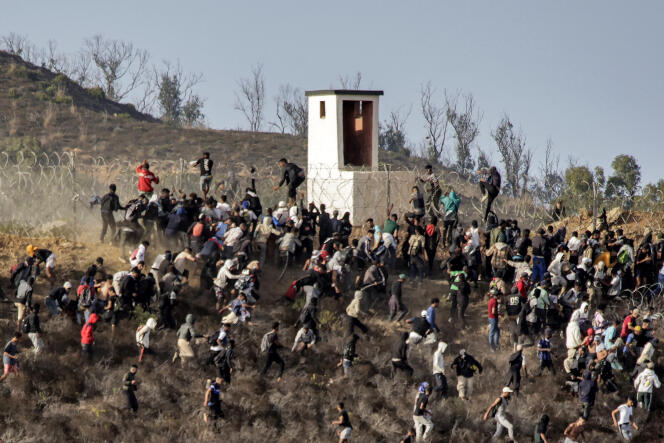
Source: Le Monde.fr Migrants attempt to enter the Spanish enclave of Ceuta, near Fnideq in northern Morocco, on September 15, 2024. – / AFP
The idealized “European dream” is often oversold, putting thousands of young lives at risk each year. This reality won’t change without addressing underlying issues: changing mindsets, implementing more effective policies, and promoting digital literacy. While Moroccan authorities are taking steps to tackle misinformation on social media and condemn incitement, educating migrants about the risks and offering verified information is crucial.
It’s particularly urgent, given that a new call has already surfaced, inviting more young people to join another mass migration attempt on September 30. This highlights the need for sustainable, humane policy solutions that go beyond mere border enforcement.
The mass migration attempt from Morocco is a complex issue, rooted in socio-economic challenges, policy failures, and evolving digital landscapes. It’s time to move beyond simple border enforcement and address the deeper causes driving migration. Tighter borders only make individuals switch to more dangerous routes in the hope of a better life.
If you’re interested in these issues, join the conversation, follow my blog, and let’s advocate together for informed, compassionate solutions.


 Your Global Compass
Leave a comment