

One of the most intriguing developments on the global stage today is the evolving relationship between China and Africa. Beijing’s ambition is most definitely reaching beyond its borders, and its engagement with Africa has become a focal point of discussion in international politics. The Forum on China-Africa Cooperation (FOCAC), founded in 2000, has been at the heart of this deepening partnership, and it serves as a platform for both continents to establish and nurture diplomatic, economic, and strategic ties. But what does this growing relationship mean for the future of international relations? Are we witnessing the rise of a new world order that challenges the long-standing dominance of the USA?
The latest FOCAC summit was held earlier this month from 4-6 September 2024, marking a significant milestone in this partnership. This summit brought together leaders from across Africa and China, emphasizing the strategic importance of this relationship and laying out new goals for the future. The forum covered eight main aspects: Connectivity and Infrastructure, Medical and Health Programs, Green Development, Trade and Investment, Poverty Alleviation and Agriculture, Capacity Building, Digital Innovation, and Peace and Security. The map below provides an overview on China’s Bilateral Agreements during FOCAC 2024. Keep in mind that:
- Soft infrastructure includes agriculture, education, health, local economic development, tech, and telecommunications projects.
- Trade includes currency swaps and export agreements.
- Public relations includes cultural exchange and media sharing agreements.
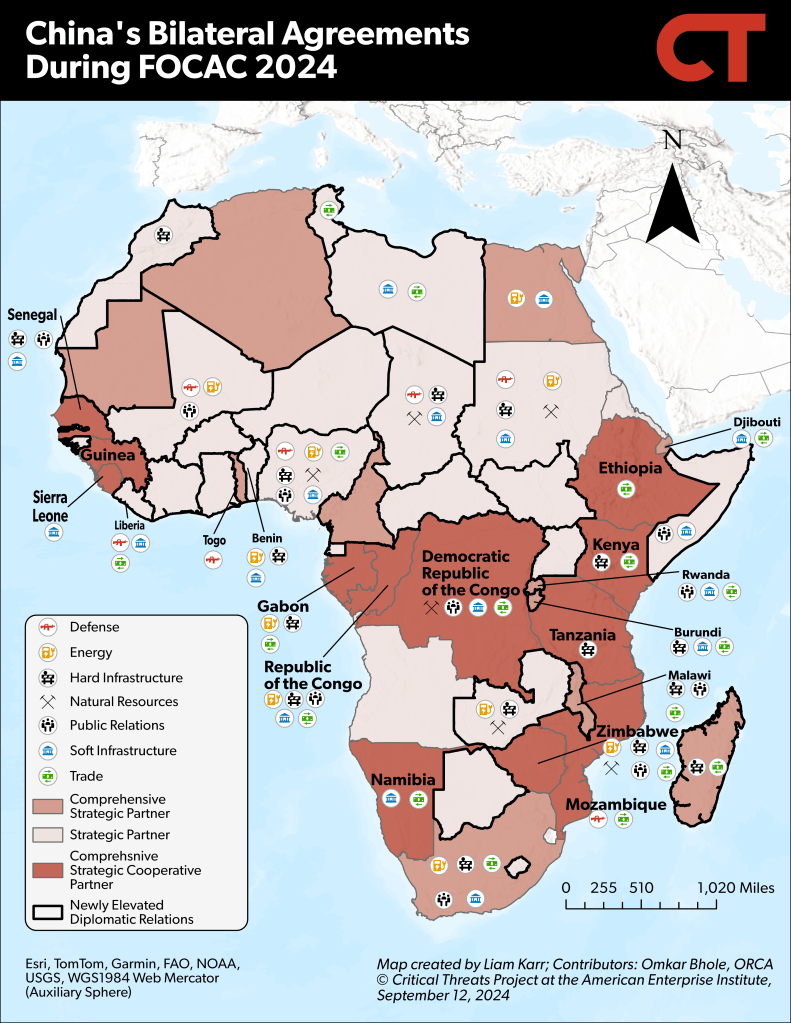
Key highlights from the summit and the updated Beijing Action Plan (2024-2025) include:
- Increased Investment and Trade: During the summit, President Xi Jinping announced that China will provide 360 billion yuan (more than $50 billion) in financial support to the continet over the next three years. This is on top of the pledge to expand Chinese imports from Africa, following up on its “$300 billion in total imports by 2025” plan.
- Infrastructure Development: Infrastructure remained a top priority at the summit, with new agreements signed to invest in transportation networks, energy projects, and digital infrastructure. This commitment to building roads, railways, and ports will enhance intra-African trade and connectivity with global markets.
- Health and Technological Cooperation: The summit also addressed public health challenges, especially in the wake of the COVID-19 pandemic. China committed to supporting Africa’s health sector by establishing more health centers, distributing vaccines, and sharing expertise. Additionally, there was a strong emphasis on technological cooperation, including plans to expand digital infrastructure and introduce 5G networks in more African countries.
The outcomes of the September 2024 summit demonstrate Beijing’s intention to position itself as a key partner in Africa’s development, focusing on mutual growth, technological advancement, and infrastructure support.
Why is China seeking a greater presence in Africa?
Over the past two decades, China’s presence in Africa has evolved significantly, driven by a blend of economic ambitions and shifting priorities. While securing natural resources like oil and minerals remains a vital motive (since China was, for a long time, the biggest buyer of these resources needed to fuel its economy) today, the country has shifted its focus toward technology transfer, digital infrastructure, and healthcare partnerships. Now, the investments are moving beyond the traditional sectors and into building telecommunications networks and supporting public health initiatives, a shift highlighted in recent analyses of China-Africa relations. This broader engagement reflects Beijing’s recognition of Africa’s growing importance not just as a source of resources, but as a strategic partner in global affairs. By fostering closer ties through education, cultural exchanges, and capacity building, China aims to create a mutually beneficial relationship that supports its global aspirations while contributing to Africa’s development. However, this deepening involvement also raises questions about debt sustainability and the long-term impact on African economies, underscoring the need for careful navigation to ensure that partnerships remain equitable and supportive of local priorities.
China’s intensified interest in Africa can be attributed to four key factors. First, Africa is home to a wealth of natural resources, from oil in Nigeria and Angola to cobalt in the Democratic Republic of Congo (DRC). These resources are critical for China’s industrial machinery and technology sector, especially in producing batteries for electric vehicles. By establishing a foothold in Africa, China ensures a steady supply chain for its industries. Second, China is focused on expanding its market. Its domestic market has become saturated, and it needs new markets to sustain its economic growth. With a growing middle class and youthful population, Africa presents an untapped market for Chinese goods, technology, and services. The third factor is geopolitical influence. China’s presence in Africa allows it to strengthen its geopolitical clout, particularly in regions where Western influence has waned. By positioning itself as a partner in development, China is not just building roads but also diplomatic ties that can translate into political support in international forums like the United Nations. Lastly, the Belt and Road Initiative (BRI) is China’s grand vision to connect Asia, Africa, and Europe through infrastructure and trade networks. Africa’s inclusion in this initiative is crucial for China to achieve its goal of creating a global supply chain that reduces dependency on Western routes and networks.
A New World Order: A Shift Away from the USA?
As China’s influence in Africa grows, one of the main questions that arises is about the potential for a shift in global power dynamics, especially since the two are not big fans of each other. The USA has long been a dominant player in international politics, but China’s approach in Africa presents a different model of cooperation and engagement. Let’s do a comparative analysis:
| How China’s approach is different from the USA: | |
| Development Model vs. Aid Model: | Unlike Western countries that often tie aid to governance reforms and human rights, China’s model is based on investment and infrastructure development with few strings attached. This has made China an attractive partner for African countries prioritizing economic growth over political conditionality. |
| Soft Power Expansion | China’s cultural engagement in Africa, from Confucius Institutes to media partnerships, is steadily increasing its soft power. These initiatives promote Chinese language and culture, making China not just a financial but also a cultural partner. This differs from the USA’s approach, which often focuses more on political influence and military partnerships. |
| Challenging the Dollar Hegemony | In trade agreements with African countries, China has increasingly used the Yuan, reducing the dependence on the US dollar. This shift towards a multipolar currency system could weaken the dollar’s dominance in international trade over time. |
| A Multipolar World | Beijing’s engagement with Africa is part of a larger strategy to create a multipolar world where power is distributed among various global players rather than being concentrated in the hands of a few. African nations, often sidelined in international decision-making, see China as a partner that acknowledges their sovereignty and agency. |
However, it’s essential to note that China’s rise doesn’t mean the USA is irrelevant in Africa. The U.S. still maintains significant influence, especially in the realm of security and humanitarian aid. The question is not whether China will replace the USA but whether we are moving towards a more balanced, multipolar global order where African countries have more choices and agency. China’s approach of “pragmatic cooperation” offers an alternative to the Western model, challenging the traditional power structures that have defined Africa’s international relations for decades. Whether this signals the dawn of a new world order remains to be seen, but one thing is clear: Africa is no longer just a battleground for influence between global powers; it’s becoming an active participant in shaping the future of international relations.
As China continues to deepen its ties with Africa, the rest of the world will be watching closely. Will Beijing’s engagement lead to sustainable development and true partnership, or will it be another chapter in the story of external powers extracting value from the continent? Only time will tell.
For more in-depth details, check: https://2024focacsummit.mfa.gov.cn/eng/



 Your Global Compass
Leave a comment