

With just two months left in 2024, the world is facing severe humanitarian crises across multiple regions, fueled by conflicts, famine, economic collapse, and mass displacement. Millions of people are suffering from a lack of food, healthcare, and basic services, while international organizations struggle to meet their urgent needs. Though mainstream media often focuses on a few key conflicts, it’s crucial to gain a broader understanding of the most pressing global humanitarian emergencies. For instance, in Sudan, violent conflict has displaced millions and crippled essential services. Yemen remains engulfed in famine and its healthcare system is in ruins due to a prolonged civil war. Meanwhile, in Syria, over a decade of civil war has left millions displaced and reliant on aid, and Palestine, particularly Gaza, faces worsening violence and blockades. Lebanon is also grappling with a severe economic collapse and one of the highest refugee burdens in the world.
This blog series will explore these critical crises in three parts, starting with Part 1, highlighting the urgent need for global action in Sudan, Yemen, Syria, Palestine, and Lebanon.
1- Sudan
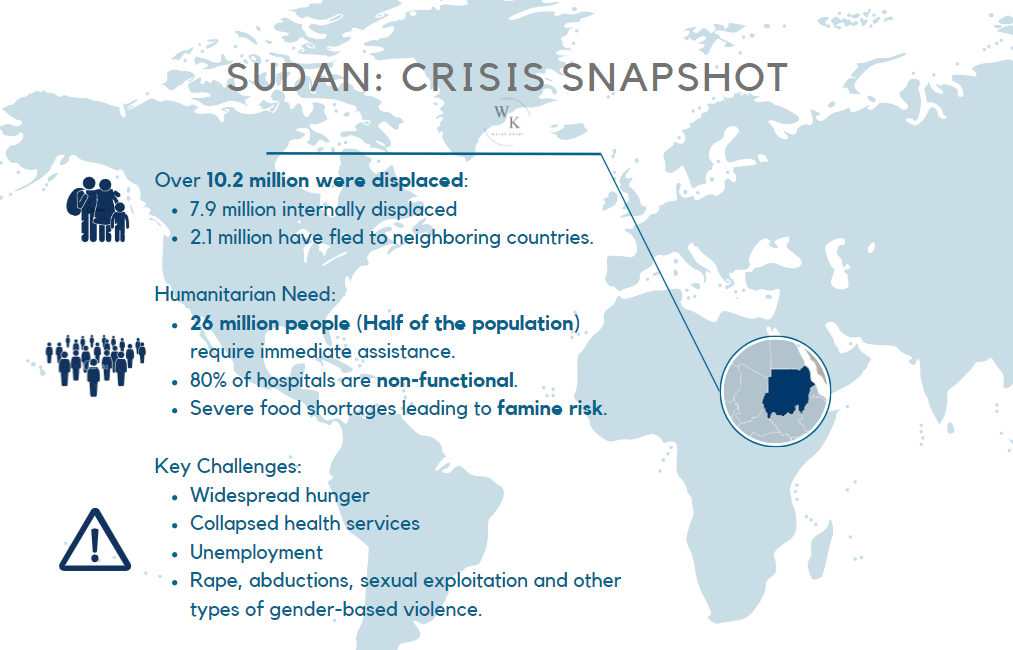
Sudan faces one of the world’s most alarming and urgent humanitarian crises. What we see today is happening after decades of political instability and economic fragility. Since gaining independence in 1956, Sudan has been torn apart by conflict, most notably the Darfur crisis in 2003 and the crisis between the North and the South, which eventually led to South Sudan’s secession in 2011. In 2023, the situation escalated due to power struggles between the Sudanese Armed Forces (SAF) and the paramilitary Rapid Support Forces (RSF), which later erupted into full-scale conflict.
As of 2024, over 6 million people have been displaced due to the ongoing violence, both within Sudan and across borders into neighboring countries like Chad (629,524), South Sudan (166,955), and Egypt (500,000). The fighting has taken down communities, with Khartoum and Darfur being some of the hardest-hit regions. The violence in the country has led to the paralysis of essential services and put over 26 million people in urgent need of humanitarian aid and protection. Furthermore, Sudan’s borders continue to be overwhelmed with refugees fleeing the violence, further straining resources in neighboring countries like Chad and South Sudan, and humanitarian organizations still have difficulty reaching the affected populations due to non-stop fighting and the collapse of public services.
2- Yemen
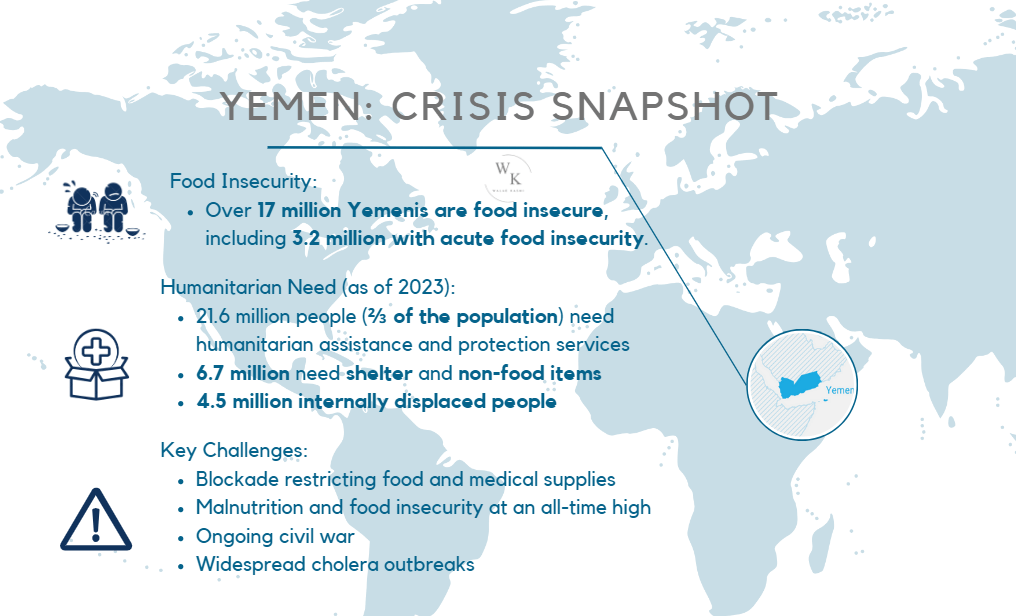
After nearly a decade, Yemen remains one of the world’s worst humanitarian disasters. The conflict, which began in 2015 as a civil war between the Houthis (AKA Ansar Allah) and governmental forces, has devastated the country’s infrastructure and economy. The crisis has been further exacerbated by the proxy involvement of Saudi Arabia, which leads a coalition responsible for blockades and airstrikes, and Iran, accused of militarily supporting the Houthis, thereby prolonging the conflict and worsening the humanitarian catastrophe.
Today, 21.6 million people, or two-thirds of the population, require humanitarian assistance, with 17 million Yemenis facing food insecurity, including 3.2 million in acute conditions, leaving millions on the brink of famine. The country’s healthcare system has also collapsed due to the civil war as well as widespread cholera outbreaks. Furthermore, 4.5 million people are internally displaced, with millions more in need of shelter, highlighting the dire state of the humanitarian situation. Blockades and ongoing conflict are only restricting the ability of aid organizations to deliver much-needed help, while rampant malnutrition and poverty continue to affect the most vulnerable, especially children. On top of all this, the war has also led to an energy crisis, with frequent power outages preventing hospitals from functioning correctly and exacerbating an already dire situation.
3- Syria
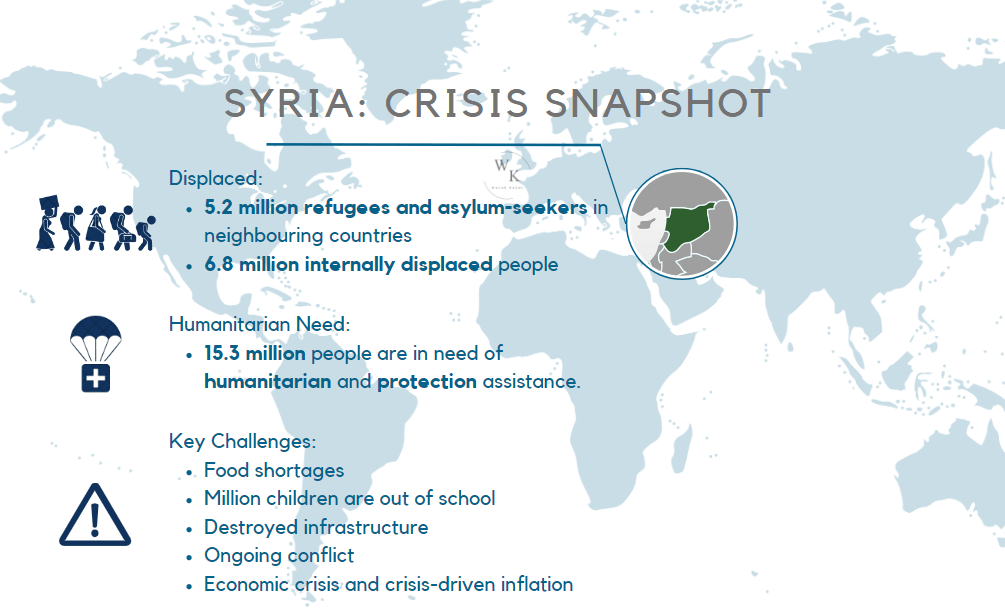
Syria’s humanitarian crisis began with the outbreak of civil war in 2011. Over the last decade, the conflict has displaced millions, both within and outside the country, resulting in one of the largest refugee crises globally. As of 2024, 5.2 million Syrian refugees have sought asylum in neighboring countries like Turkey, Lebanon, and Jordan, while an additional 6.8 million people are internally displaced within Syria. Nowadays, 15.3 million people urgently need humanitarian assistance within the country, mainly due to the widespread food shortage, destroyed infrastructure, and an overwhelmed healthcare system. Moreover, the conflict has also taken a heavy toll on education, with millions of children out of school, contributing to a lost generation of young Syrians. The dire economic situation, with crisis-driven inflation, makes basic goods unaffordable for many families.
As the conflict enters its 13th year, there is little hope for a swift resolution, and the humanitarian needs remain massive. International organizations struggle to provide aid, while many parts of Syria remain difficult to access due to ongoing violence. UNHCR reports that over 753,000 Syrian refugees are in dire need of resettlement.
4- Palestine
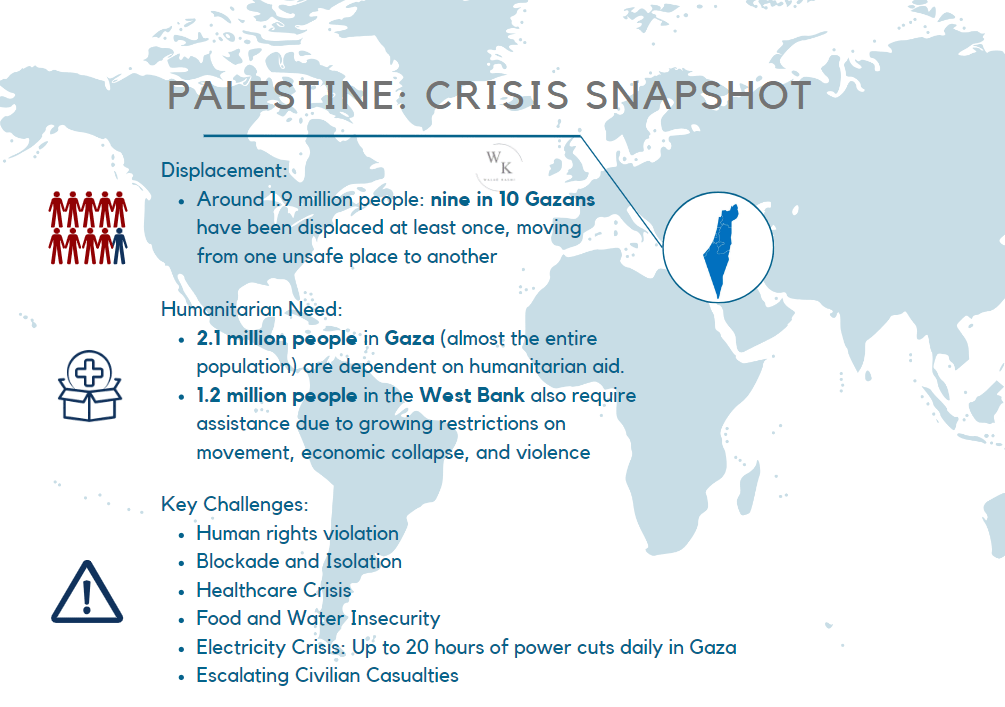
The humanitarian situation in Palestine, particularly in Gaza, continues to worsen today as the region experiences escalating violence and severe socio-economic challenges. With nine in ten Gazans displaced at least once, forced to move from one unsafe location to another, the sense of insecurity and instability is pervasive. In Gaza, nearly the entire population of 2.1 million people is reliant on humanitarian aid for survival. The blockade that has been in place for more than a decade severely restricts the flow of essential goods, medical supplies, and aid, pushing families further into poverty. This isolation has not only crippled Gaza’s economy but has also created a healthcare emergency. Today, all hospitals are overwhelmed and suffering from severe shortages of essential medical supplies, and this is aggravated by the electricity crisis of up to 20 hours of power cuts per day, preventing hospitals from providing consistent care.
Today, 80% of Gazans face food insecurity, and access to clean water remains a critical challenge, with many relying on contaminated sources. In addition, 1.2 million people in the West Bank also require assistance due to increasing restrictions on movement, economic collapse, and escalating violence. On top of all, the blockade and ongoing conflict have led to significant human rights violations, with escalating civilian casualties. As violence intensifies, the already dire situation in Palestine deteriorates further, leaving millions without the necessities of life, dependent on humanitarian aid that struggles to reach those in need.
5- Lebanon
Lebanon was once a trading center and considered a beacon of economic and social prosperity in the Middle East. Today, however, it is facing crisis after crisis and is especially struggling with an economic collapse, mass migration, and a crumbling healthcare system, which has left over 3.7 million people in need of urgent humanitarian assistance (including both Lebanese nationals and Syrian refugees) and pushed over 50% of the population below the poverty line.
As of 2024, 541,527 people are internally displaced in Lebanon, adding to the country’s significant refugee burden, which is among the worst in the world. Lebanon hosts the highest number of refugees per capita, with nearly 1.5 million Syrian refugees residing within its borders. This massive influx has placed immense pressure on already overstretched public services, housing, and employment opportunities, leaving both Lebanese citizens and refugees in a constant struggle for survival.
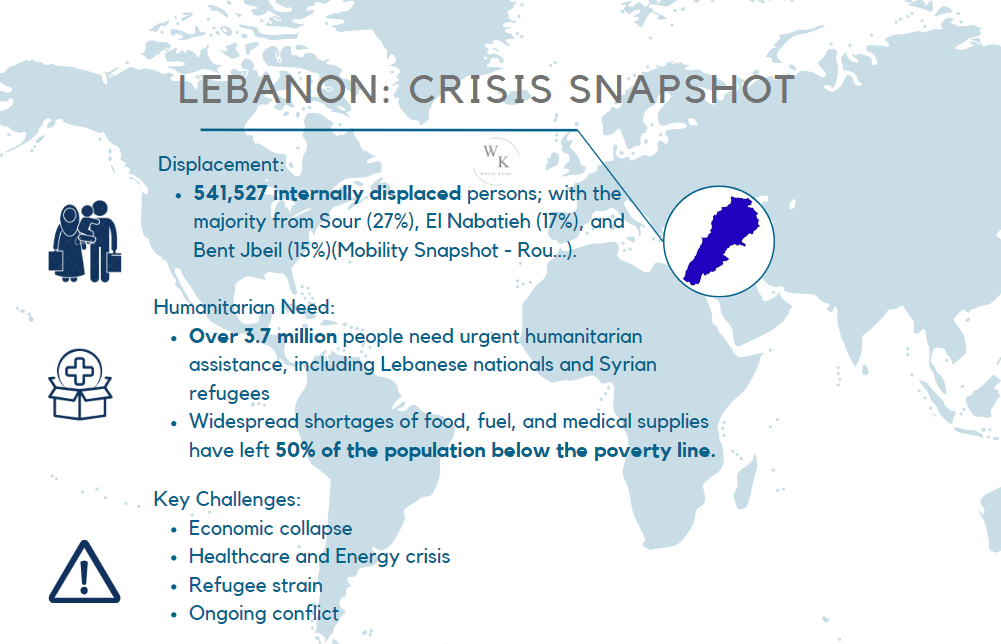
Note: The crisis snapshots in this blog were created by Walae Kasmi, drawing from various credible resources such as UNHCR, IOM, the Migration Data Portal, IRC, ReliefWeb, and reports from various UN agencies to bring you reliable data that illustrates the depth of the humanitarian challenges discussed.
For more information about Sudan, check:
https://www.unrefugees.org/news/sudan-crisis-explained/
https://www.rescue.org/eu/article/fighting-sudan-what-you-need-know-about-crisis
For more information about Yemen, check:
https://www.unrefugees.org/news/yemen-crisis-explained/
https://reliefweb.int/country/yem
For more information about Syria, check:
https://reporting.unhcr.org/syria-situation-global-appeal-2024
https://data.unhcr.org/en/situations/syria
https://www.concern.net/news/syria-crisis-explained
For more information about Palestine, check:
https://www.middleeastmonitor.com/
For more information about Lebanon, check:
https://www.unrefugees.org/news/what-is-happening-in-lebanon/



 Your Global Compass
Leave a comment